How I helped Abhimanyu to get inside chakravyuga using AI

Jev – the new kid on the (X) block!
On September 16 2026, TypeSafeAI – a new AI model research lab, introduced a new type of AI model called Jev in a X post with an accompanying video and a blog post, where they mentioned it is the first model under a new class of models called SystemOne Models.
Under the hood, SystemOne models appears to be decision answering models. Today, when you ask a LLM to generate structured outputs, LLMs still are predicting the next token as they have been trained and produces a set of logits for each token in the vocabulary. The model then samples from this distribution to generate the next token. This is a probabilistic approach and the way in which the final logit is sampled from the distribution ties to another aspect called “preference optimization” which is a fancy way of saying that the model is trained to generate outputs that are more likely to be preferred by humans. This is the reason why LLMs are good at generating text, but not so good at generating structured outputs.
As more & more LLMs are being used in production, the need for structured outputs increased, which then prompted (no pun intended) these frontier model companies to train these models to produce good formed structured outputs. But, the underlying architecture of predicting the next token is still same. Which means, the model doesn’t discriminate between prose and structured outputs and you pay the same token pricing nevertheless.
Consider some special usecases like asking the LLM to score an emotional attribute like customer satisfaction from a support transcript or asking the LLM to generate a routing decision based on set of rules and raw unstructured inputs etc. In these cases, LLMs are not generating prose, but rather generating a decision or a score. But you still pay the same token pricing and subject to same latency since the tokens are still being generated sequentially.
What SystemOne models are claiming is that, they are a special category of models that are trained to produce typed schemas outputs and they expose the raw logits with probability likelihood as it is. They call it as Reinforcement Learning for Calibrated Decisions (RLCD). In other words, they are not predicting the next token. Instead, they produce the logits for the entire schema at once along with the model’s confidence in the form of probability distribution. This is a very different approach than LLMs and it is more efficient in terms of latency and cost since the model is not generating tokens sequentially. Plus, since the model is not generating prose, the entire aspect of preference optimization is not applicable and that cut down the TTFT (time to first token) and the cost of inference.
They are claiming it is so cheap that, their API pricing only includes the price for processing input tokens. Output tokens are FREE!. Infact, they say “(too cheap to meter).”
Jev vs Diffusion Models and my understanding of it
In X, several people are claiming this is just text diffusion wrapped in a fancy new term. Some even claim to have reproduced Jev by fine tuning Qwen models to produce logit probabilities and some say they modified the architecture of Qwen decoder to remove the sampling steps etc.
Typesafe AI has responded with “Good luck” and their FAQs have addressed some of these in different forms. To me, both diffusion and Qwen rearchitecture are similar but not same as Jev. In case of diffusion models, there is a concept of denoising and the model is trained to remove noise to produce output pixels aligned into input text. This happens through various steps in sucesssive manner. In case of repurposing an LLM to actually produce logit probabilities, the model is still generating tokens sequentially and the logits are being produced for each token. It is like asking the LLM to convert the produced token (english text) back to some case types. By this time, the model has already executed the sampling steps aligned to the preference optimization and the logits are not raw anymore. Both are not happening in Jev as per my understanding.
Jev’s 3 TypeSafe Primitives
What Jev is a universal classifier model, that takes unstructured input text data1 and produces one of the 3 outputs:
- It can pick a choice from a set of choices (like a multiple choice question), given the state and input
- It can produce a score (like a regression problem), given the state, range and input
- Given a statement, it can answer true or false. Classic binary classification problem.
and that’s it. The model is not generating any prose or text. It is just producing a decision or a score. These decision or score is then returned as typed schema which downstream applications can reliably parse and use it according to their business logic.
Jev’s documentation mentions 3 primitives that are used to build the Jev models. They are:
| Primitive Type | Goal | Returns |
|---|---|---|
| Choice | Choose an option from a list | choice, probabilities, confidence |
| Score | Score the state on a rubric | score, probabilities, confidence |
| Noul | Is this statement true? | noul (0–1) |
And what about confidence vs probabilities ?
Typesafe AI has got a detailed writeup on their docs page, but my read on this is : Consider confidence as the model’s way of abstracting the probabilities to the task at hand. In other words, lets say you ask a question with choices and the model produces a choice with high confidence, it means it has semantically assigned that confidence in relation to the input and state.
Probabilities are simply the most likelihood distribution of the logits for each choice. In other words, it is the raw output of the model’s logits. Confidence is a more abstracted version of probabilities and is more useful for downstream applications to make decisions and this is where the training moat from Typesafe AI comes into play. They say they also return the raw probabilities as well to make it even more useful for the downstream applications, should their confidence score abstraction is not working amicably. Pretty neat and transparent IMO.
They have trained the model to produce confidence scores that are more aligned to the task at hand and not just raw probabilities. This is the reason I’m claiming RLCD is not the same as asking LLM to output probabilities or diffusion.
Common Usecases for Jev
In X, several people are posting really cool demos and usecases for Jev. Of which, majority of them are around Gaming, next action prediction given the state, self driving simulators, Trading, the boring spam / not spam classification, and other extensions like flagging a tweet into different buckets to self curate the TL etc.
Amidst those, I did find few nuggets which I shared as a thread in X and I will keep adding to it as I find more interesting usecases. Here is the link to the thread: https://x.com/reachmeviz/status/2100753741016146299?s=20
To reiterate, any usecase that requires a decision to be made interms of a choice, a scale or a true/false statement, can be a good candidate for Jev. The model is not generating any prose or text, but rather producing a decision or a score. This is the reason why I mentioned it is a universal classifier model.
My fav @typesafeai 's Jev demos so far (apart from generic games, self driving, browser use and ofcourse trading… which is pretty boring IMO) . A 🧵 below 👇🏻
— Viz (@reachmeviz) September 18, 2026
I'll add more to this thread as I find more and feel free to comment yours too…
How & Why I (tried to) help Abhimanyu to get inside Chakravyuga using Jev?

As soon as the announcement of Jev was made, I first tried to understand what this is about. Honestly, TypesafeAI did a poor job in explaining it though. It took several passes for people to comprehend what they were trying to sell. Once I understood the working model, I immediately signed up for the waiting list and got access to the API2. To my surprise, they did offer 5$ credit for all beta users. Its time to experiment something.
I turned to my good friend Sarathy. I told him about Jev and pointed the docs link and asked him to suggest a topic to experiment. Him being my assistant, knowing my inkling towards the epic mahabharata, suggested the task of helping Abhimanyu to get inside Chakravyuga as the problem statement for Jev to solve.
Intrigued by this suggestion, I provided following details to Sarathy to help him frame the problem statement for Jev:
- 3 difficulty levels for the polar maze
- options to have / not have warriors at each ring
- No game logic. Every more should be coming from Jev as a decision output. The portal app should simply take the snapshot of the game board as coordinates, provide choices as set of moves with the instruction to help abhimanyu to reach the centre and return the decision output from Jev to the portal app. The portal app should then execute the move and provide the next snapshot to Jev for next move.

Some observations :
Sarathy tried many variations to see how Jev performs. Even though Jev accepts multiple parallel questions, if we apply the same for predicting all moves in one go, the performance was very poor. This is acceptable since in this game, the next move is dependent on the previous move and the state of the game board. So, I decided to ask Jev for one move at a time and provide the next state of the game board as input for next move. This worked OK, not well. This was because, the app was applying the moves verbatim without focussing on the confidence score, Jev was returning.
Once again, I asked Sarathy to include the confidence score as part of the move acceptance criteria. If the confidence score is below a threshold, the app should not accept the move, mark that as misstep, replace it with actual calculated move as per the game logic and provide the next state of the game board to Jev for next move. This provided a nice visualization of how reliable Jev’s confidence score was – the moat as per their claim.
In my experiment, I found that out of 24 attempts, Jev was 81% deterministic in providing right moves with high confidence score. i.e Jev’s confidence score was directly proportional to the correctness of the move.
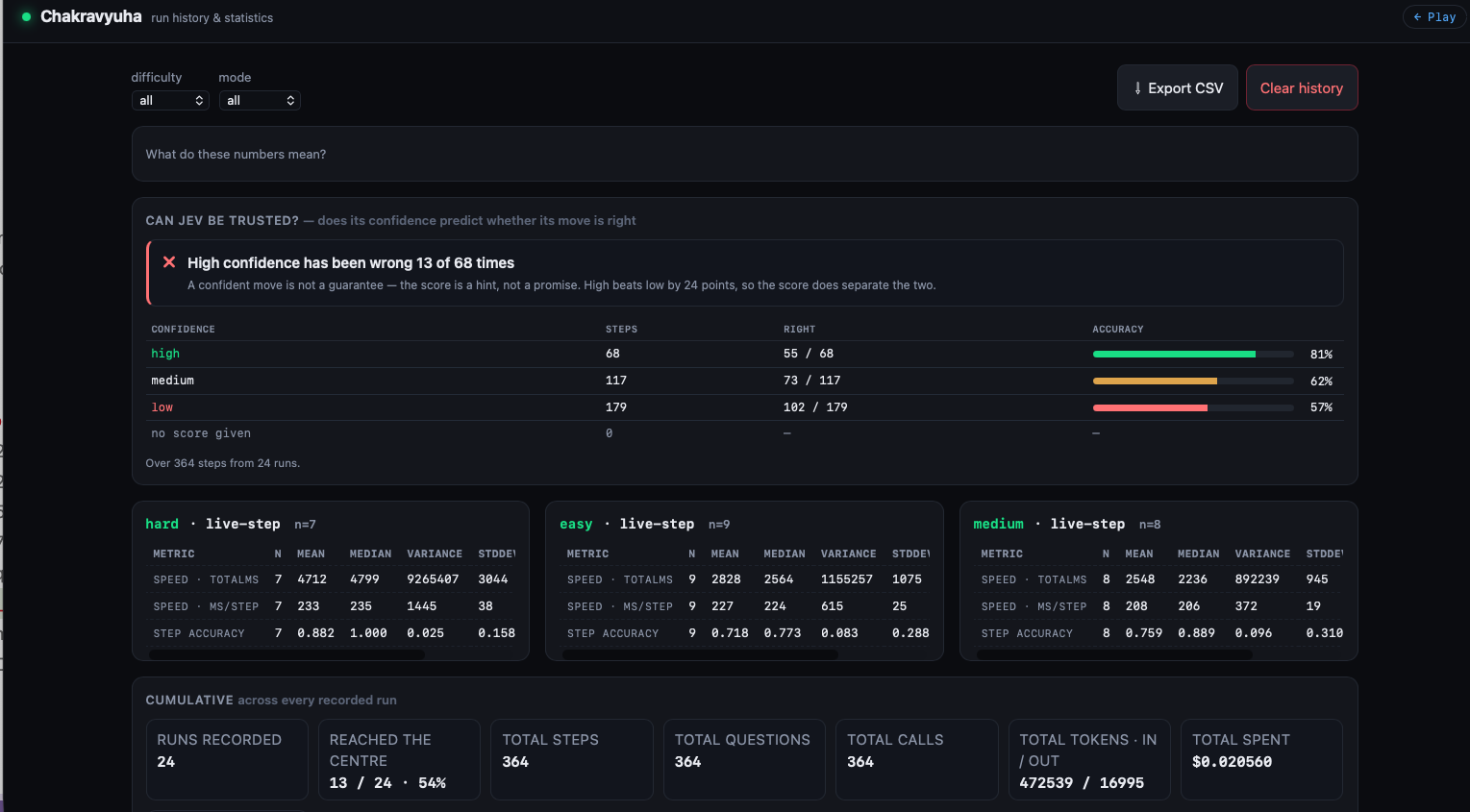
You can find the source code for this experiment in my github repo.
I also publish a newsletter where I share my techo adventures in the intersection of Telecom, AI/ML, SW Engineering and Distributed systems. If you like getting my post delivered directly to your inbox whenever I publish, then consider subscribing to my substack.
I pinky promise 🤙🏻 . I won’t sell your emails!
Footnotes
I’m not sure about the multi-modality inputs yet. It can be part of their future offerings, but as far as I can see, these are text only models↩︎
This is also a funny story. Earlier the wait list were exploding and several people started complaining about it. Luckily one TypeSafeAI engineer was awake at that time (yeah it was during wee hours) and he decided to open the flood gates. So without any scrutiny, everyone part of the wait list got admitted, including me↩︎